


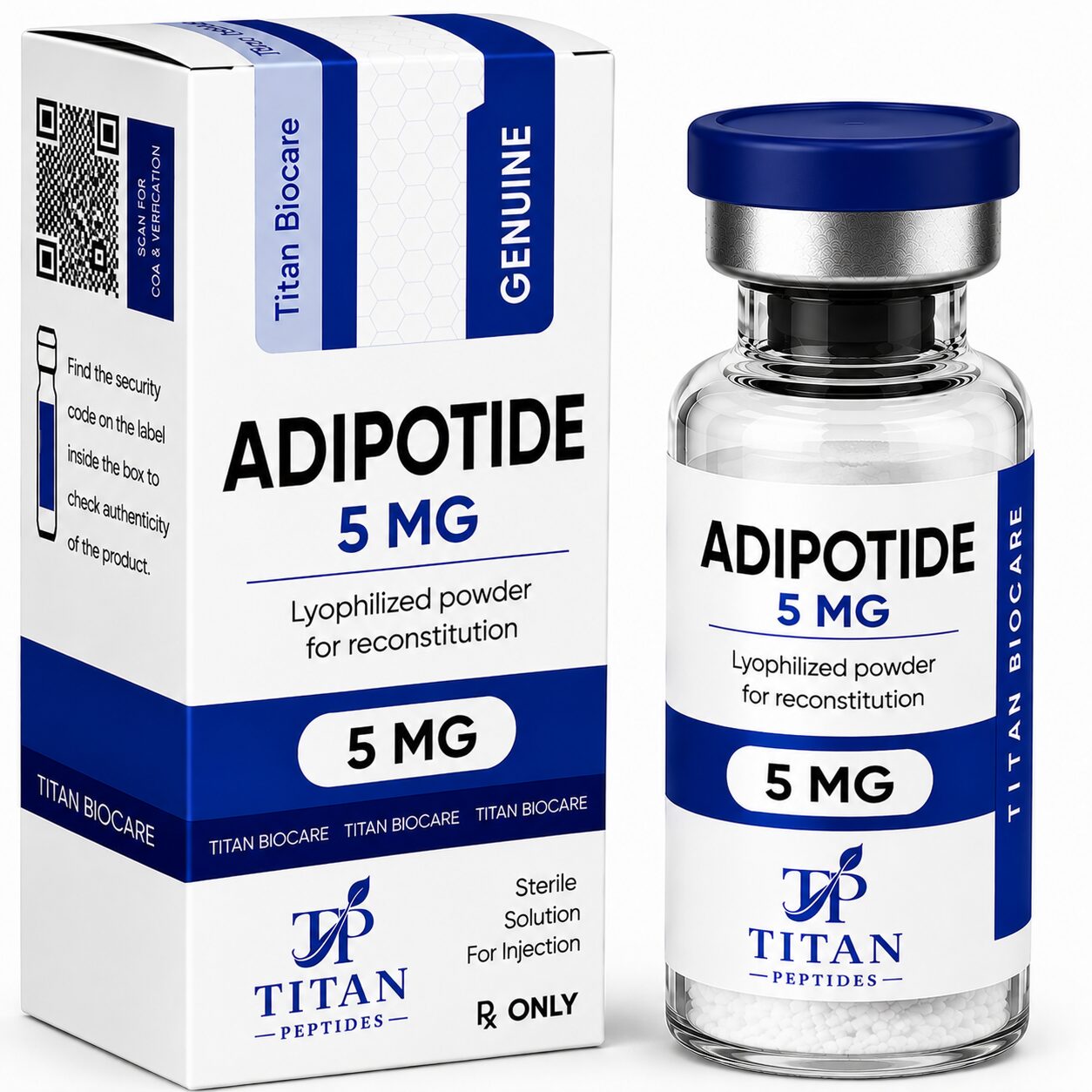
Adipotide 5mg 1kit
$195.00
Adipotide FTPP is a synthetic research peptide investigated for its ability to interact with vascular targets associated with white adipose tissue. Research has focused on its proapoptotic properties, metabolic signaling, glucose tolerance, and mechanisms involving prohibitin and Annexin A2. Adipotide remains an experimental compound intended for laboratory and in-vitro research rather than human or veterinary use.
What Is Adipotide?
Adipotide is a synthetic peptide that has been investigated for its ability to selectively interact with vascular structures associated with white adipose tissue. Unlike compounds that are studied primarily for direct effects on adipocytes, the research surrounding Adipotide FTPP has focused on the blood vessels supplying white fat.
Early experimental research proposed that Adipotide could recognize molecular targets associated with the vasculature of adipose tissue. Following this interaction, the peptide’s proapoptotic component may interfere with cellular survival mechanisms, potentially resulting in the loss of targeted vascular cells.
Animal research, including studies involving rhesus monkeys, has investigated whether these mechanisms may be associated with reductions in body weight, changes in adipose tissue, and alterations in metabolic markers. These observations remain preclinical and should not be interpreted as established effects in humans.
Adipotide Specifications
Other Known Name: Adipotide
Molecular Formula: C152H252N44O42
Molecular Weight: 2611.41 g/mol
Sequence: Cys-Lys-Gly-Gly-Arg-Ala-Lys-Asp-Cys-Gly-Gly-(Lys-Leu-Ala-Lys-Leu-Ala-Lys)2
Research Classification: Synthetic peptide for laboratory research
Adipotide FTPP Research
Adipotide Mechanism of Action
Research into Adipotide has centered on its interaction with two proteins known as Annexin A2 (ANXA2) and prohibitin (PHB).
Both proteins occur in multiple biological tissues, but experimental studies have proposed that they can form a receptor system with particular relevance to the blood vessels associated with white adipose tissue. These vascular structures are involved in supplying nutrients and other factors to adipocytes.
Researchers have also investigated the relationship between ANXA2, prohibitin, and CD36, a protein involved in fatty-acid transport. Experimental evidence suggests that these proteins may work together to influence the movement of fatty acids from endothelial cells into adipose cells.
Disrupting the interaction between ANXA2 and prohibitin has been investigated as a way of examining fatty-acid transport within white adipose tissue. These studies have contributed to the hypothesis that the ANXA2-prohibitin system could represent a pathway involved in regulating adipose tissue biology.
Prohibitin is also a multifunctional membrane-associated protein involved in cellular survival and growth. Because of these characteristics, researchers have explored whether targeting prohibitin-associated pathways could influence programmed cell death in specific experimental models.
The proposed mechanism of Adipotide peptide activity is therefore based on vascular targeting rather than simply acting directly on fat cells.
Adipotide FTPP Structure
The structure of Adipotide FTPP contains two principal functional regions.
The targeting sequence is commonly represented as CKGGRAKDC. Experimental research identified this sequence through peptide-screening techniques designed to locate peptide motifs capable of recognizing specific molecular targets.
The second component is the proapoptotic sequence (KLAKLAK)2. This portion has been investigated for its ability to affect mitochondrial membranes after entering targeted cells.
The combination of these regions gives Adipotide its research interest: the targeting sequence may help direct the peptide toward specific vascular structures, while the proapoptotic portion may subsequently interfere with cellular membrane integrity and survival pathways.
Experimental studies have consequently examined whether this mechanism can selectively affect blood vessels associated with white adipose tissue.
Adipotide and White Adipose Tissue
One of the primary areas of Adipotide research involves white adipose tissue (WAT).
Researchers have proposed that the peptide’s targeting sequence can interact with prohibitin-associated structures on endothelial cells surrounding white fat. Following this interaction, the proapoptotic component may become internalized and affect mitochondrial function.
The resulting cellular changes have been investigated for their ability to reduce the vascular support available to adipose tissue.
Animal experiments have reported reductions in adipose tissue under certain research conditions. However, these findings are specific to experimental models and do not establish that Adipotide produces equivalent effects in humans.
Research has also considered whether vascular targeting could influence different forms of adipose tissue, including subcutaneous and visceral fat. These studies have helped establish Adipotide as an experimental tool for investigating the relationship between adipose vasculature, fat storage, and metabolic signaling.
Adipotide and Cancer Research
Another area of investigation involves the relationship between prohibitin, vascular biology, and cancer.
Many tumors depend on extensive vascular networks to support continued growth and expansion. Because prohibitin has been identified in several types of cancer-related research, scientists have explored whether targeting prohibitin-associated pathways could provide a mechanism for selectively studying tumor-associated vasculature.
This does not mean that Adipotide is an established cancer treatment. Rather, the peptide has been investigated as a research tool for understanding vascular targeting and programmed cell death.
Researchers have also examined the broader relationship between obesity and certain cancers. Several biological pathways have been proposed, including insulin and IGF-1 signaling, sex-hormone activity, adipokine signaling, and chronic inflammation.
Insulin and IGF-1 pathways have received particular attention because metabolic changes associated with obesity may influence cellular proliferation. Similarly, adipose tissue can participate in hormonal and inflammatory signaling through molecules such as leptin, adiponectin, and interleukin-6.
These observations provide scientific context for studying compounds such as Adipotide in experimental models involving adipose tissue and cancer biology.
Adipotide and Metabolic Research
Glucose tolerance is another area in which Adipotide FTPP has been investigated.
Experimental animal studies have reported changes in glucose tolerance following exposure to Adipotide, including observations that were not necessarily proportional to changes in overall body weight.
Researchers have proposed that these metabolic effects could be connected to alterations in white adipose tissue rather than simply resulting from reduced food intake.
Because adipose tissue plays an important role in energy storage and metabolic signaling, changes in adipose tissue biology can potentially influence glucose regulation. Experimental research has therefore examined Adipotide as a tool for investigating connections between adipose vasculature, fat tissue, and metabolic function.
However, these findings should remain within their experimental context and should not be interpreted as evidence for treating diabetes or metabolic disease.
Adipotide and Fat-Loss Research
Research involving rhesus monkeys has examined the potential relationship between Adipotide and changes in adipose tissue.
The proposed mechanism involves targeting vascular structures that supply white fat. If these targeted cells undergo apoptosis, the resulting vascular changes may affect the associated adipose tissue.
Some animal studies reported reductions in body weight, body mass index, and measures associated with insulin sensitivity. Changes in food intake were also observed in some experimental subjects, making it difficult to attribute every observed effect to a single mechanism.
For this reason, researchers continue to investigate whether the changes associated with Adipotide are primarily attributable to direct effects on adipose tissue, altered vascular support, appetite-related changes, or a combination of factors.
The distinction is important when interpreting Adipotide peptide research because laboratory findings do not automatically translate into predictable outcomes in humans.
Adipotide Dosage Research
The term Adipotide dosage is commonly searched in connection with experimental studies and research protocols. However, there is no established or approved human dosage for Adipotide.
Available research concerns experimental models under controlled laboratory or animal-study conditions. Experimental quantities, administration methods, and study protocols should therefore not be interpreted as recommendations for human use.
For legitimate laboratory research, researchers should rely on the specific experimental protocol, institutional requirements, applicable regulations, and relevant primary literature rather than attempting to extrapolate a research quantity into a human dose.
Adipotide is not presented here as a medication, treatment, weight-loss product, or therapeutic compound.
Adipotide FTPP and Future Research
The vascular-targeting properties of Adipotide FTPP have made it a subject of continuing preclinical investigation.
Research has primarily explored how peptide targeting can be used to investigate blood vessels associated with adipose tissue. This approach may provide researchers with greater insight into the relationship between vascular biology, adipose tissue maintenance, metabolic signaling, and programmed cell death.
Anti-angiogenic and vascular-targeting strategies have also attracted scientific interest in cancer research because tumors depend heavily on blood-vessel formation and maintenance.
For Adipotide specifically, future research would be necessary to clarify its molecular targets, pharmacological characteristics, tissue selectivity, safety profile, and potential applications. Existing animal and laboratory findings are not sufficient to establish clinical efficacy or safety in humans.
Adipotide Research Summary
Adipotide is an experimental synthetic peptide investigated primarily for its interaction with vascular targets associated with white adipose tissue.
Its research profile includes several major areas:
- Interaction with Annexin A2 and prohibitin
- Vascular targeting of white adipose tissue
- Proapoptotic cellular mechanisms
- Mitochondrial membrane disruption
- Fatty-acid transport research
- Glucose-tolerance studies
- Adipose-tissue biology
- Cancer and vascular research
- Animal-model investigations of body-weight changes
The Adipotide peptide remains a research compound, and findings from preclinical models should not be presented as established human outcomes.
Research-Use Disclaimer
The information provided on this page is intended strictly for educational and scientific research purposes. Adipotide FTPP is supplied as a research chemical for qualified laboratory investigation, analytical work, and/or in-vitro experimentation.
This product is not intended for human or animal consumption and should not be used as a medicine, dietary supplement, weight-loss product, or therapeutic treatment. No dosage or administration instructions for human or veterinary use are provided.
Researchers and qualified professionals should follow applicable laws, institutional procedures, laboratory safety requirements, and relevant scientific literature when handling research materials.
Be the first to review “Adipotide 5mg 1kit”
Related products


Reviews
There are no reviews yet.